

Where pretrained language models fit in recommender systems
This post covers the three gaps Pretrained Language Models (PLMs) fill, the approaches emerging at each, and the open alignment problem that sits underneath all of them.

The three gaps
Recommender systems are built on behavioral signals such as clicks, purchases, watch time, skips etc. These signals are powerful when they exist, but they leave three blind spots that pretrained language models are uniquely positioned to fill.
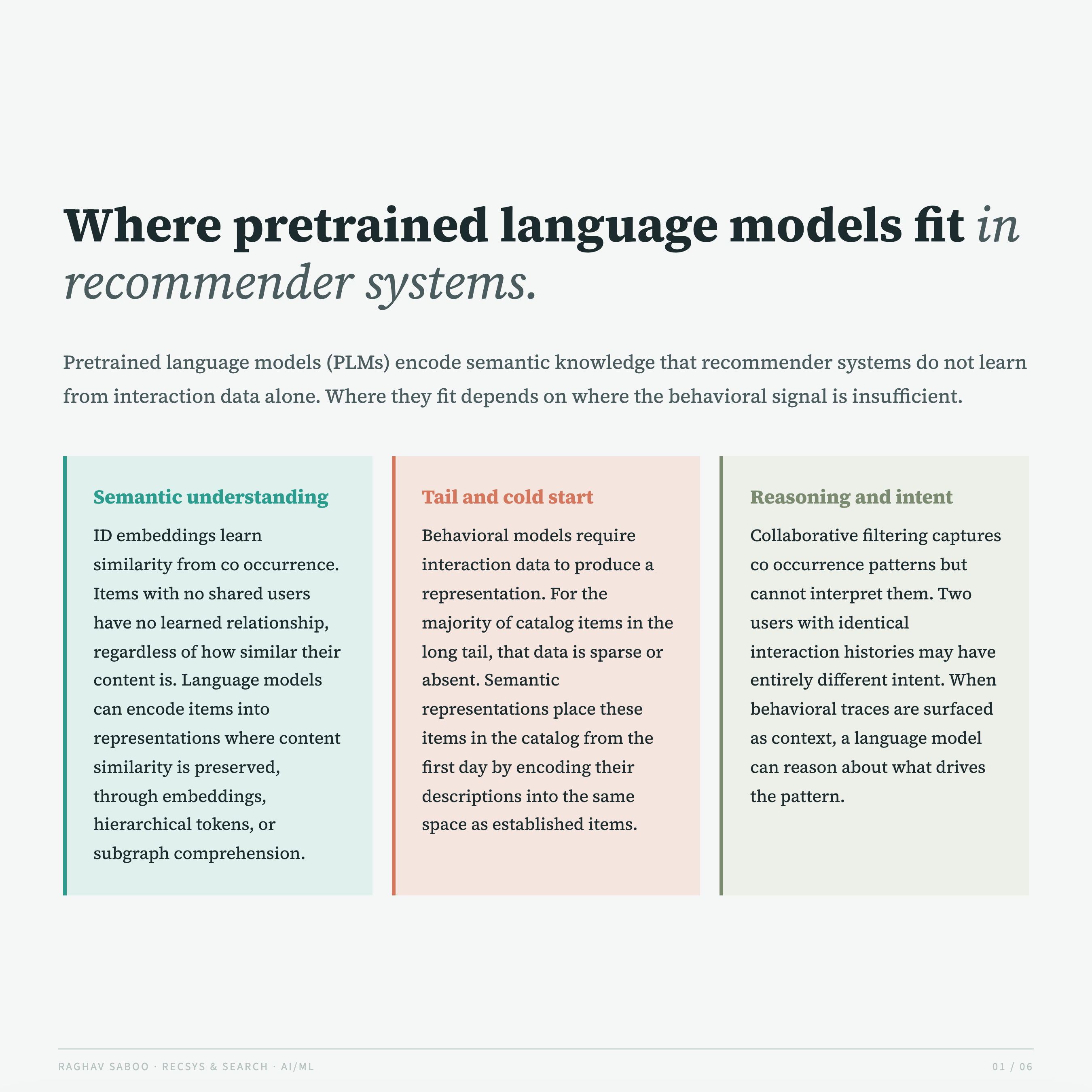
1. Semantic understanding
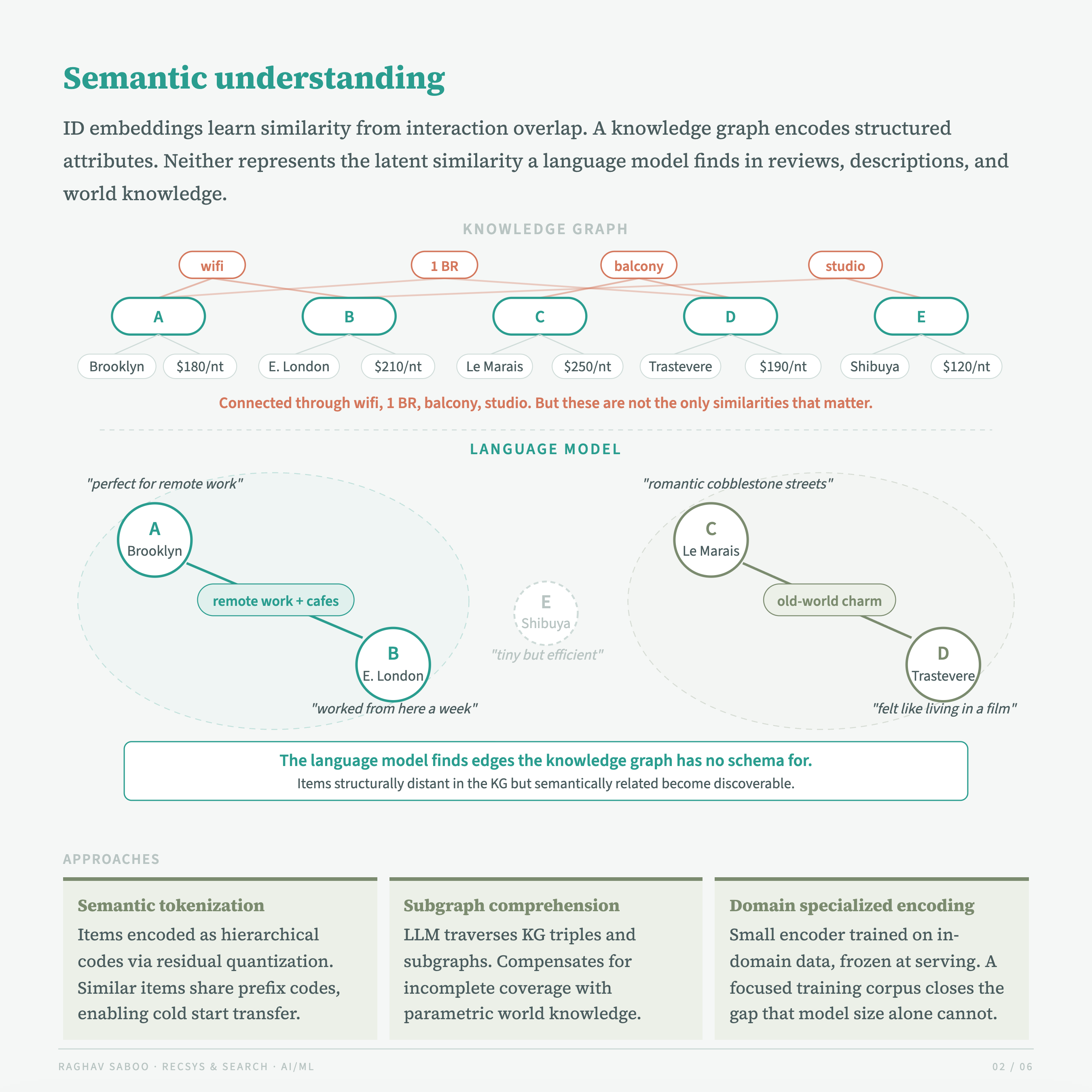
ID embeddings learn similarity from co-occurrence. Items with no shared users have no learned relationship, regardless of how similar their content is. A knowledge graph encodes structured attributes. Neither represents the latent similarity a language model finds in reviews, descriptions, and world knowledge.
Consider five Airbnb listings: a Brooklyn apartment, a flat in East London, a place in Le Marais, one in Trastevere, and a studio in Shibuya. A knowledge graph connects them through structured attributes — wifi, 1 BR, balcony, studio. But these are not the only similarities that matter.
A language model finds edges the knowledge graph has no schema for. It connects the Brooklyn and East London listings through “perfect for remote work” and “cafes.” It groups Le Marais and Trastevere under “old-world charm” and “romantic cobblestone streets.” It reads “worked from here a week” in a review and links it to listings an attribute-based system would never surface together. Items structurally distant in the knowledge graph but semantically related become discoverable.
Approaches emerging here:
Semantic tokenization. Items encoded as hierarchical codes via residual quantization. Similar items share prefix codes, enabling cold start transfer.
Subgraph comprehension. LLM traverses knowledge graph triples and subgraphs. Compensates for incomplete coverage with parametric world knowledge.
Domain specialized encoding. Small encoder trained on in-domain data, frozen at serving. A focused training corpus closes the gap that model size alone cannot.
2. Tail and cold start coverage
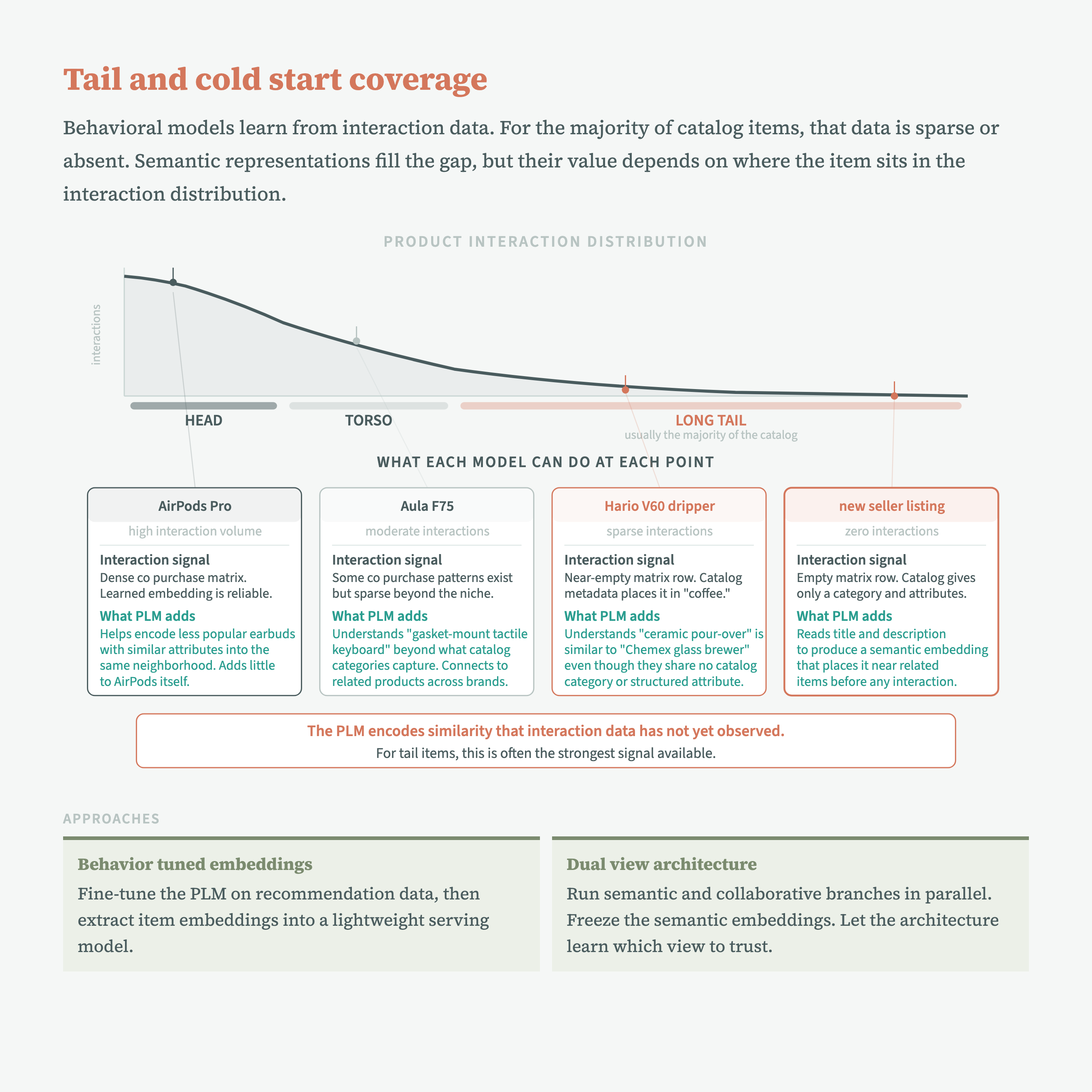
Behavioral models learn from interaction data. For the majority of catalog items, that data is sparse or absent. Semantic representations fill the gap, but their value depends on where the item sits in the interaction distribution.
Think about the interaction distribution as a long tail curve. At the head, you have items like AirPods Pro — high interaction volume, dense co-purchase matrix, reliable learned embeddings. The PLM helps here by encoding less popular earbuds with similar attributes into the same neighborhood, but it adds little to AirPods itself.
Move to the torso: something like an Aula F75 keyboard with moderate interactions. Some co-purchase patterns exist but are sparse beyond the niche. The PLM understands “gasket-mount tactile keyboard” beyond what catalog categories capture, connecting related products across brands.
Further into the tail: a Hario V60 dripper with sparse interactions. Near-empty matrix row. Catalog metadata places it in “coffee.” The PLM understands “ceramic pour-over” is similar to “Chemex glass brewer” even though they share no catalog category or structured attribute.
And at the very long tail: a new seller listing with zero interactions. Empty matrix row. The PLM reads title and description to produce a semantic embedding that places it near related items before any user interacts with it. For tail items, this is often the strongest signal available.
Approaches emerging here:
Behavior tuned embeddings. Fine-tune the PLM on recommendation data, then extract item embeddings into a lightweight serving model.
Dual view architecture. Run semantic and collaborative branches in parallel. Freeze the semantic embeddings. Let the architecture learn which view to trust.
3. Reasoning and intent
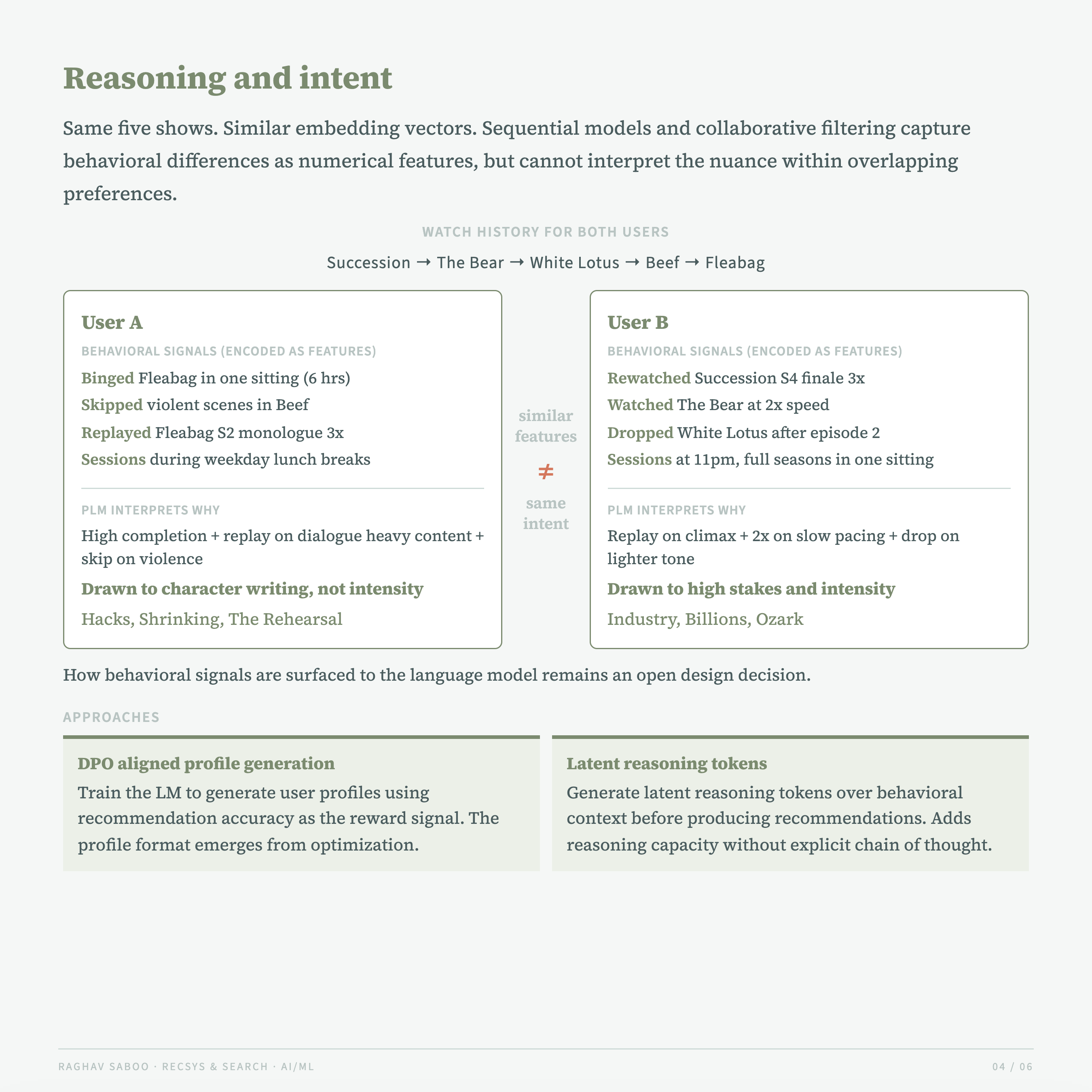
Collaborative filtering captures co-occurrence patterns but cannot interpret them. Two users with identical interaction histories may have entirely different intent.
Imagine two users who watched the same five shows: Succession, The Bear, White Lotus, Beef, and Fleabag. Similar embedding vectors. Sequential models and collaborative filtering capture the behavioral differences as numerical features, but cannot interpret the nuance within overlapping preferences.
User A binged Fleabag in one sitting (6 hours), skipped violent scenes in Beef, replayed the Fleabag S2 monologue 3x, and watched during weekday lunch breaks. User B rewatched the Succession S4 finale 3x, watched The Bear at 2x speed, dropped White Lotus after episode 2, and watched at 11pm in full-season sessions.
When behavioral traces are surfaced as context, a language model can reason about what drives the pattern.
User A: high completion + replay on dialogue-heavy content + skip on violence — drawn to character writing, not intensity. Recommend Hacks, Shrinking, The Rehearsal.
User B: replay on climax + 2x on slow pacing + drop on lighter tone — drawn to high stakes and intensity. Recommend Industry, Billions, Ozark.
How behavioral signals are surfaced to the language model remains an open design decision.
Approaches emerging here:
DPO aligned profile generation. Train the LM to generate user profiles using recommendation accuracy as the reward signal. The profile format emerges from optimization.
Latent reasoning tokens. Generate latent reasoning tokens over behavioral context before producing recommendations. Adds reasoning capacity without explicit chain of thought.
The open problem
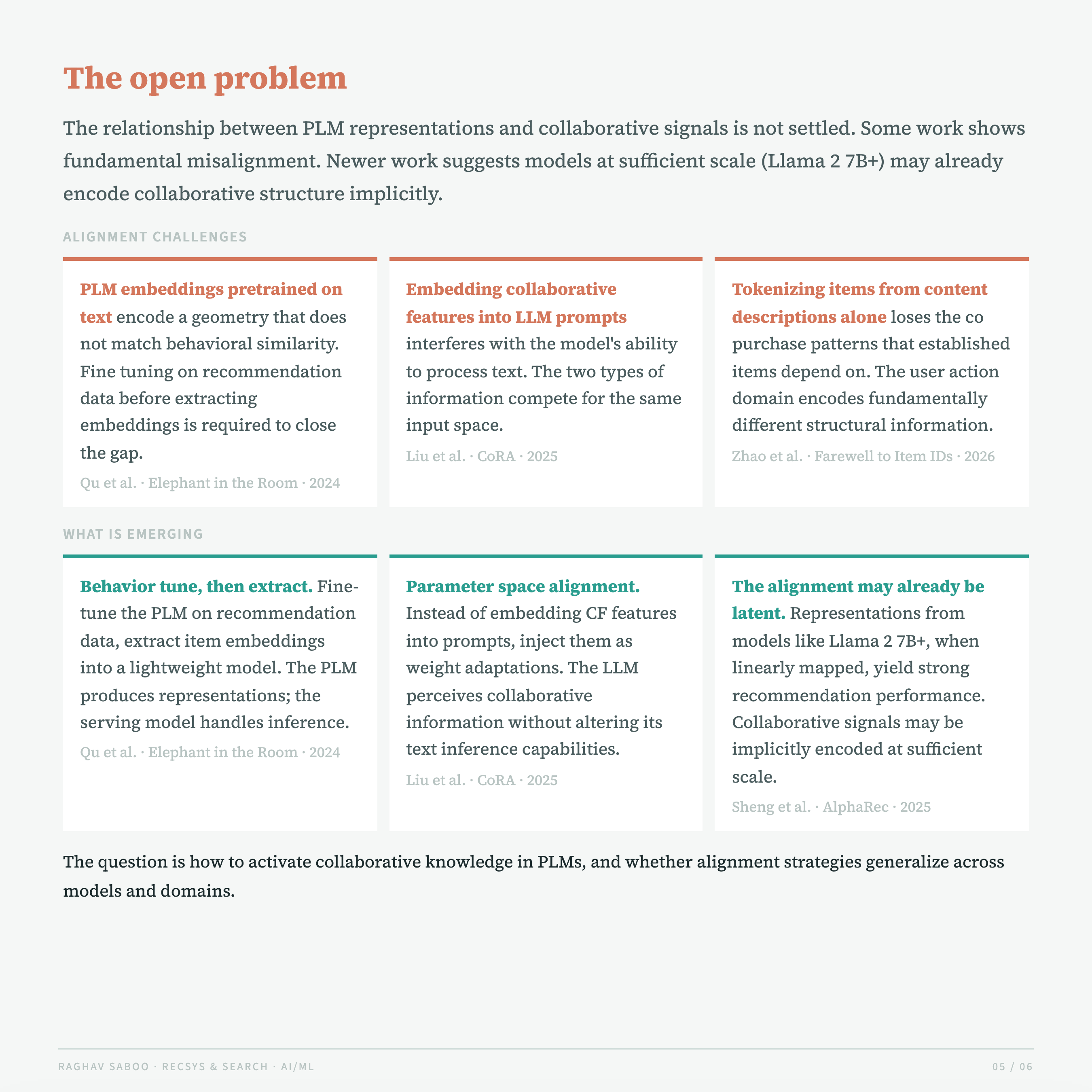
The relationship between PLM representations and collaborative signals is not settled. Some work shows fundamental misalignment. Newer work suggests models at sufficient scale (e.g. Llama 2 7B+) may already encode collaborative structure implicitly.
Alignment challenges
PLM embeddings pretrained on text encode a geometry that does not match behavioral similarity. Fine tuning on recommendation data before extracting embeddings is required to close the gap. (Qu et al. Elephant in the Room 2024)
Embedding collaborative features into LLM prompts interferes with the model’s ability to process text. The two types of information compete for the same input space. (Liu et al. CoRA 2025)
Tokenizing items from content descriptions alone loses the co-purchase patterns that established items depend on. The user action domain encodes fundamentally different structural information. (Zhao et al. Farewell to Item IDs 2026)
What is emerging
Behavior tune, then extract. Fine-tune the PLM on recommendation data, extract item embeddings into a lightweight model. The PLM produces representations; the serving model handles inference. (Qu et al. Elephant in the Room 2024)
Parameter space alignment. Instead of embedding CF features into prompts, inject them as weight adaptations. The LLM perceives collaborative information without altering its text inference capabilities. (Liu et al. CoRA 2025)
The alignment may already be latent. Representations from models like Llama 2 7B+, when linearly mapped, yield strong recommendation performance. Collaborative signals may be implicitly encoded at sufficient scale. (Sheng et al. AlphaRec 2025)
The question is how to activate collaborative knowledge in PLMs, and whether alignment strategies generalize across models and domains.
Where the work is heading
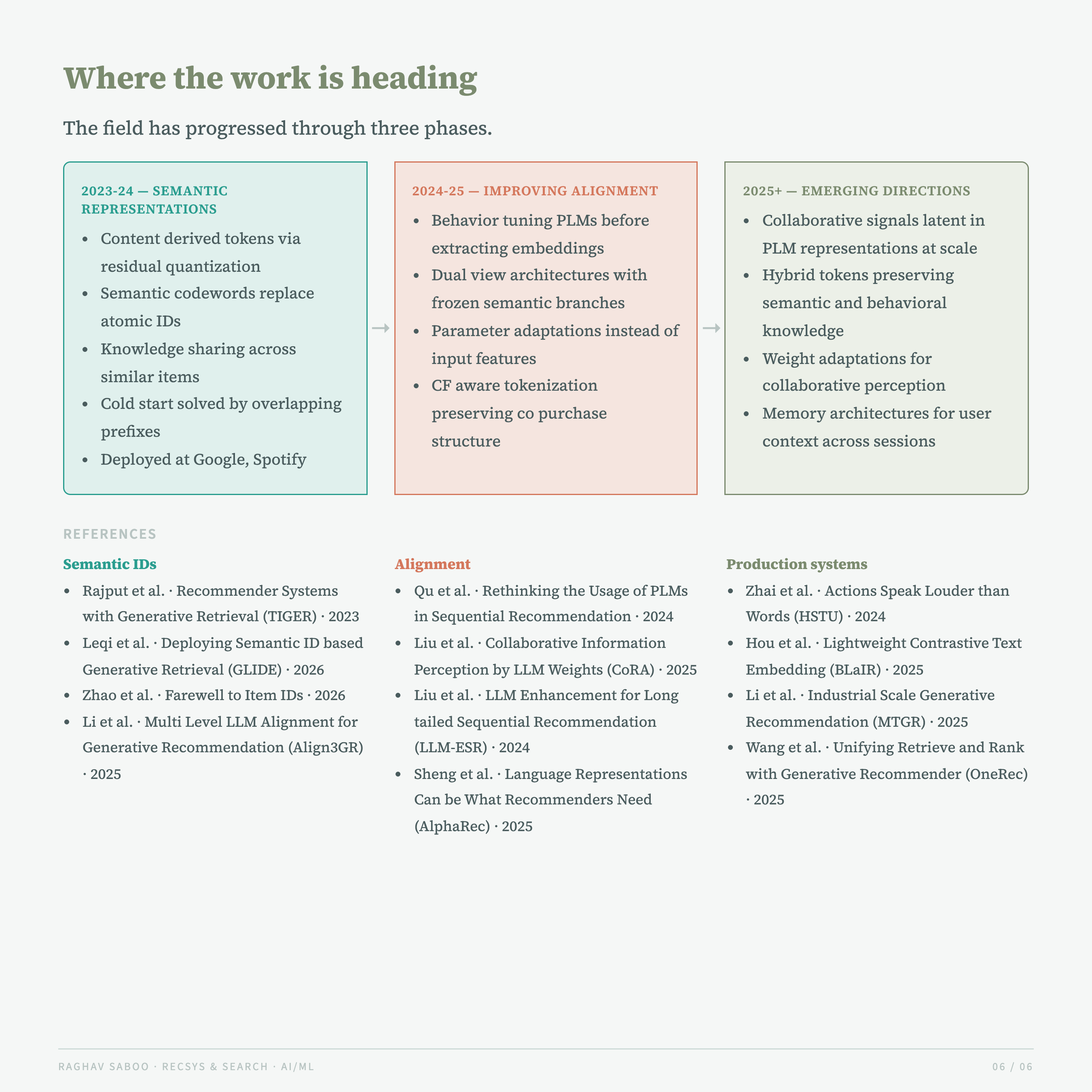
The field has progressed through three phases.
2023 - 24: Semantic representations. Content derived tokens via residual quantization. Semantic codewords replace atomic IDs. Knowledge sharing across similar items. Cold start solved by overlapping prefixes. Deployed at Google, Spotify.
2024 - 25: Improving alignment. Behavior tuning PLMs before extracting embeddings. Dual view architectures with frozen semantic branches. Parameter adaptations instead of input features. CF-aware tokenization preserving co-purchase structure.
2025+: Emerging directions. Collaborative signals latent in PLM representations at scale. Hybrid tokens preserving semantic and behavioral knowledge. Weight adaptations for collaborative perception. Memory architectures for user context across sessions.
References
Semantic IDs
Rajput et al. Recommender Systems with Generative Retrieval (TIGER) 2023
Leqi et al. Deploying Semantic ID based Generative Retrieval (GLIDE) 2026
Zhao et al. Farewell to Item IDs 2026
Li et al. Multi Level LLM Alignment for Generative Recommendation (Align3GR) 2025
Alignment
Qu et al. Rethinking the Usage of PLMs in Sequential Recommendation 2024
Liu et al. Collaborative Information Perception by LLM Weights (CoRA) 2025
Liu et al. LLM Enhancement for Long Tailed Sequential Recommendation (LLM-ESR) 2024
Sheng et al. Language Representations Can be What Recommenders Need (AlphaRec) 2025
Production systems